|
|
 |
|
|
|
; "Click to enlarge - Please be patient")
The main war memorial in Fremantle which is located on Monument Hill. |
|
; "Click to enlarge - Please be patient") Fremantle today, view from the Town Hall clock tower looking down High Street towards the ocean (click here for a different view of the town). |
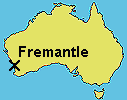
Fremantle
was established in 1829 as a port for the newly established Swan River
Colony. The first settlers landed in this year and later on their numbers
were strengthened by the arrival of convicts from Britain. Fremantle became
the Western gateway for Australia and became the 2nd most important town
in WA behind the capital city of Perth. It's importance as a working harbour,
fishing & maritime centre is still reflected to the present day. Pre
European settlement, the Fremantle region was a meeting place for Aboriginal
people, and attracted many English & other nationalities of immigrants
in the 19th & early 20th century. In particular Fremantle has a strong
Portuguese & Italian community. In World War One more than 3000 men
enlisted from this area, and in WW2 Fremantle at one stage of the war became
the largest submarine base in the southern hemisphere and was a major staging
point in the war against Japan. Fremantle has a strong heritage which is
reflected in it's buildings, culture and people.
|
 |
|
; "Click to enlarge - Please be patient")
"Greater love hath no man that he lay down his life for another" |
George
Edward Rushby
George Edward Rushby was born in 1894
in South Fremantle, Western Australia and attended the local Beaconsfield
State School and resided at 107 Douro Rd South Fremantle.
After his schooling, Rushby went on to become a clerk and also spent his time serving in the Volunteer Citizen Forces as part of the Royal Australian Naval Reserve. Rushby offered his services to the AIF on May 26th 1915 and was successfully enlisted. Rushby was allotted to the 16th Battalion with the service number 2521 and after a very short time spent training at Blackboy Hill camp in the foothills of Perth, Rushby and his fellow reinforcements sailed for Egypt in June 1915. After another small amount of training in Egypt, Rushby and his fellow reinforcements sailed for Gallipoli. It would prove to be a short stay at Gallipoli as in the August battles in which the 16th Battalion was heavily involved, Rushby was severely wounded and after time in hospital, it was decided to send him back to Australia in November 1915. When he had recovered sufficiently, Rushby again offered his services and in December 1916 once again embarked for the war, joining the 16th Battalion in the fields of France in early 1917. Rushby served with the 16th through some of the major battles of 1917, such as Messines & Third Ypres and was decorated for his courage with the award of the Military Medal. In 1918 Rushby was involved in the defence of Hebuterne and was later moved with his battalion to the Somme front where they pushed the German line back by a process of raids called ‘Peaceful Penetration’. It was in the attack on Hamel on July 4th 1918 that Rushby was again severely wounded, unfortunately this time the wounds proved too serious and George Edward Rushby died shortly after. He is now buried in the Villers Brettoneux Military Cemetery XII.C.7. His younger brother Herbert Frank Rushby served with the 11th Battalion in 1917/18 and returned home safely. |
|
|
; "Click to enlarge - Please be patient") "May we prove worthy of this noble sacrifice RIP" |
Charles
Thomas Comben
Charles Thomas Comben was born in 1889
in Yarraville, Victoria and his family moved to Western Australia while
he was still young and settled in Fremantle.
As a youngster Charlie Comben attended the Beaconsfield State School and grew up in the surrounding areas. Comben became a Waterside Worker and with his wife, Clara resided at Harbour Trust on the North Mole in Fremantle Charlie Comben enlisted in the AIF on the 17th of January 1916 and was posted to the then forming 44th Battalion and was given the service number of 402 and the rank of Private. The 44th Battalion was the Western Australian battalion of the newly formed 3rd Division under General Monash. Initial training took place at Blackboy Hill & the Showgrounds camp, before the battalion embarked for overseas service. Arriving in England in October 1916, the battalion undertook more training at Salisbury Plain, before embarking for service in France. Charlie Comben served in the 44th’s main engagements through 1917 at Messines, Third Ypres and in 1918 on the Somme front. Charlie Comben was killed in action on the 4th of July 1918 during the attack on Hamel. He is buried in grave I.F.9 at the Villers Brettoneux Military Cemetery Fouilloy. |
|
|
; "Click to enlarge - Please be patient") |
Mark Francis
Connolly
Mark Francis Connolly was born in Ruby’s
Hill, Richmond River, New South Wales in 1897. At an early age his parents,
John & Bridget, moved the family to Western Australia, settling in
Perth Road, North Fremantle.
As a child, Mark Connolly attended St Patrick’s School in Fremantle, and soon after he left school, learnt the trade of becoming a baker. He also became a member of the citizen forces in WA. Prior to enlisting in the AIF, Connolly’s uncle, Mark Connolly, was killed on Gallipoli in July 1915 while serving with the 3rd Field Company of Engineers. Despite this, Mark Connolly offered his services to the AIF on the 28th of December 1915 and was accepted into the newly forming 44th Battalion where he was given the rank of private and the service number 123. Throughout his service with the 44th Battalion, Connolly proved to be very capable and was given the opportunity to become an NCO. Connolly also fought through most of the 44th’s major engagements and by the time of the attack on Hamel on the 4th of July 1918 had risen to the rank of Sergeant. In this attack Connolly was very seriously wounded and died of his wounds two days later on the 6th of July 1918. He is buried in Crouy-sur-Somme cemetery in France in grave III.D.15. His brother, James Patrick Connolly MID enlisted in 1914 and served out the war in the 2nd Field Artillery Brigade and successfully came home. |
|
|
; "Click to enlarge - Please be patient") |
Ernest
Roger Kelly
Ernest Roger Kelly was born and lived
most of his early life in North Fremantle, and was a student at North Fremantle
primary school.
Prior to his enlistment he was an Agricultural farmer. He enlisted in the AIF on the 31st of January 1917 and was posted to the 25th Reinforcements for the 16th Battalion with the service number 7492. After training for several months in Western Australia, his reinforcement group left on the 29th of June 1917, and on reaching England further training was undertaken with Ernest Kelly winning a medal in the smartest drill competition. As Kelly had been trained proficiently on the Lewis gun, he transferred to the 44th Battalion and saw service in France in 1917/18 with this unit. In the attack on Hamel on the 4th of July 1918, Kelly was killed, and only one of his section escaped death or injury. Sgt W Clark of the 44th recorded the following ‘I didn’t see Kelly and Pte Wise killed by a shell during the Hamel stunt and quite near the objective about 7am. It was on the left of Acroches Hill. They were buried near Vaux-sur-Somme.’ Unfortunately Kelly’s grave went missing some time after this and he is now commemorated on the Villers Brettoneux Memorial to the Missing. |
|
|
; "Click to enlarge - Please be patient") "Till we meet again" |
Henry
Newton Turner
Henry Newton Turner was born to Henry
& Annie Turner in New South Wales in 1892 and with his family moved
to Western Australia when he was young.
With most of his early life spent in the Fremantle region, including schooling, Henry Turner, before WW1, was for many years a Clerk at the Fremantle Post Office. Turner enlisted in the AIF on the 13th of February 1917 and was appointed to the 25th Reinforcements for the 16th Battalion. After a few months of initial training, this reinforcement group was sent to England and more training. Turner was soon transferred to the 44th Battalion and saw action with this unit in France during the latter half of 1917 and the first 6 months of 1918. During the attack on Hamel on the 4th of July 1918, Henry Turner was grievously wounded and died shortly after. A friend, Pte Thomas Egan from Queensland recorded this impression of Turner. ‘Pte Harry N Turner was a mate of mine and was well known in the company and a good lad. He was wounded on the morning of the 4th of July at Hamel and died at the advanced dressing station. Pte Turner had a brother in the AMC on home service for 6 months.’ He is buried in Daours Communal Cemetery France, III.D.29. His family suffered a further blow just a couple of weeks prior to the armistice when his brother, Sidney Harold Turner of the 51st Battalion died of Pneumonia in England and is buried in Compton Cemetery Wiltshire. |
|
|
; "Click to enlarge - Please be patient") |
Peter
Kemp
Peter Kemp was born in Newcastle, England
in 1880 to George & Helen Kemp. It is uncertain when Peter Kemp came
to Australia but he seems to have spent much of his early life in England
as his parents still resided there while Kemp was working in Australia.
Prior to enlistment Kemp was a Bricklayer and resided both in Cottesloe & Fremantle. Kemp enlisted on the 13th of February 1917 and was allotted to the 44th Battalion with the service number 3301. After training in Australia & England, Kemp saw service with the 44th Battalion in the latter half of 1917 and the first months of 1918. In the attack on Hamel on the 4th of July 1918, Kemp was among the 35 men of the 44th Battalion to be killed in action. Cpl EJ Stokes of the 51st Battalion gave the following information to the Red Cross. ‘I buried this man in the open about half way between Hamel and Hamlet on our side of what was Fritz’s old line. I made a small cross and stuck it on the end of a rifle and placed it on the grave. It was the only grave there. I could point out the spot. He had been dead some days. It was about the 7th July 1918 when I buried him. I got the particulars from his disc. His paybook had gone.’ He is buried in Crucifix Corner Cemetery VII.C.22 |
| Contact the author: Andrew Pittaway |  |
 |
 |
|

;)